Written By: Jerry Warner and ChatGPT-4
Last Updated: July 3, 2025
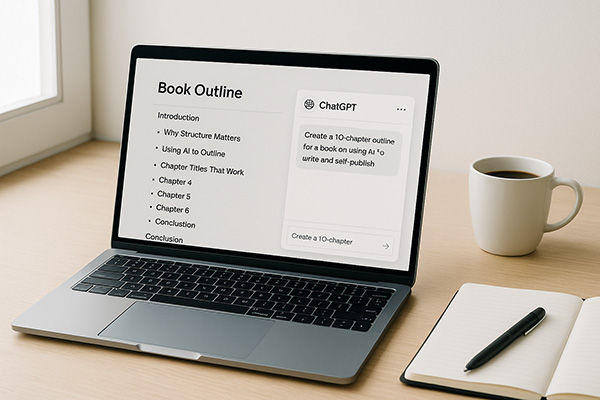
You’ve got the spark of a great book idea—but now what? You’re staring at a blank page and now wondering where to begin. The truth is, even the best ideas can stall without a solid structure. That’s where today’s post—and a little help from AI—comes in. We’re going to show you how to turn your creative spark into a clear, confident roadmap using the power of AI tools.
Let’s break this all down step by step so you can move from scattered thoughts to structured brilliance.
Why Book Structure Matters
The structure is the backbone of every successful book. Without it, writing becomes a confusing maze. With it, your message shines through, and your readers stay engaged.
A well-structured book:
- Keeps your writing focused
- Helps maintain momentum
- It makes editing 10x easier
- Creates a better experience for readers
Think of it as the blueprint to your dream home—you wouldn’t start building without it. With the structure in place, writing becomes more like painting by numbers. That’s good news for productivity and creativity.
Step 1: Start with Your Big Idea (and Let AI Help Refine It)
Begin by writing a summary of your idea—just a few sentences. Then, feed it into an AI tool like ChatGPT. Prompt example:
“Help me turn this idea into a nonfiction book outline: [Your concept].”
AI can help you:
- Clarify your audience and purpose
- Suggest a central theme or unique angle
- Expand a single idea into multiple chapters
Don’t be afraid to ask for variations. The more you experiment with prompts, the better your results will be. Bonus tip: Ask for potential titles and subtitles while you’re at it.
Example prompt:
“Generate 3 nonfiction book titles and subtitles based on this idea: A beginner’s guide to self-publishing a book using AI.”
Step 2: Build a Chapter-by-Chapter Outline
Now that you have a theme and direction, it’s time to build your skeleton—your chapter layout.
Most nonfiction books follow a logical pattern:
- Introduction (set the stage)
- 8–12 chapters (each covering a key topic)
- Conclusion (wrap-up, next steps, or transformation)
Let AI give you a starting point:
“Create a 10-chapter outline for a book that teaches people how to plan, write, and self-publish a digital book using AI tools.”
What’s great is that AI often surprises you with angles you hadn’t considered. From here, you can tweak, reorder, combine, or simplify.
Tools to use:
- ChatGPT (for generating outlines)
- Sudowrite’s Story Engine (great for pacing and chapter themes)
- Notion AI (for simple structural notes)
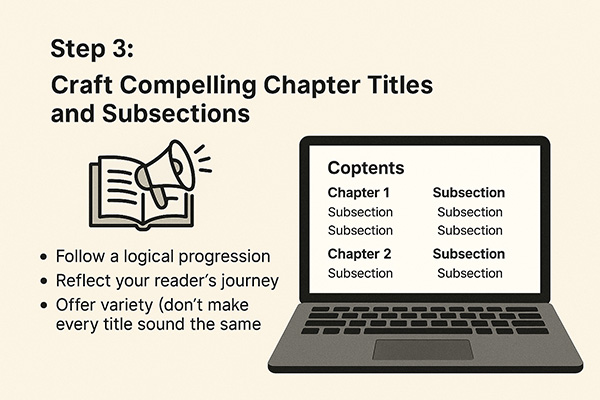
Step 3: Craft Compelling Chapter Titles and Subsections
Don’t underestimate the power of chapter titles. They hook your reader and guide your writing process.
Ask AI for help:
“Suggest catchy chapter titles for a book on using AI to publish your first eBook.”
Make sure your chapters:
- Follow a logical progression
- Reflect on your reader’s journey
- Offer variety (don’t make every title sound the same)
Also, break chapters into subsections. This improves the flow and provides writing checkpoints. AI can help you generate those, too!
Step 4: Create a Smooth Content Flow
Here’s where structure meets rhythm. A well-structured book flows like a great conversation. Use these tips to ensure smooth transitions:
- Begin each chapter by connecting to the previous one
- End with a teaser or thought that leads to the next
- Use summaries, previews, or reflection questions
Want help? Try this prompt:
“Help me transition from a chapter on outlining a book to a chapter on writing the first draft.”
AI tools like Notion AI and ChatGPT are invaluable for creating natural bridges between ideas.
Checklist for good flow:
- Does each chapter build on the last?
- Are you repeating ideas unnecessarily?
- Is there a clear arc from start to finish?
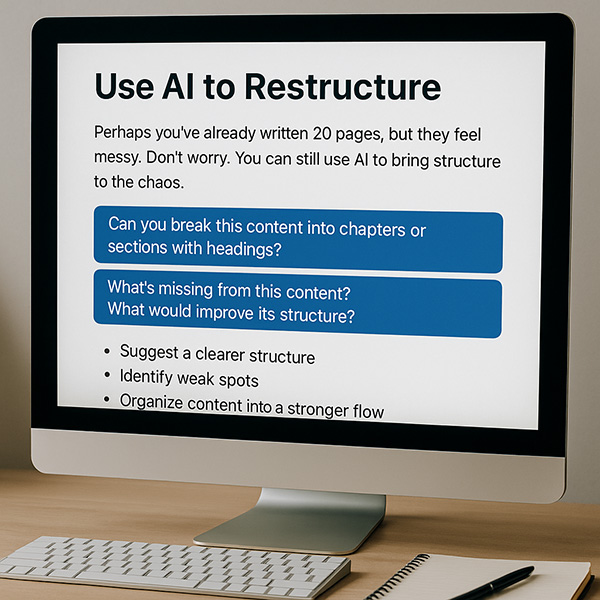
Step 5: Already Started Writing? Use AI to Restructure
Perhaps you’ve already written 20 pages, but they feel messy. Don’t worry. You can still use AI to bring structure to the chaos.
Paste a section into Claude.ai or ChatGPT and say:
“Can you break this content into chapters or sections with headings?”
Or:
“What’s missing from this content? What would improve its structure?”
You’ll be amazed how quickly AI can:
- Suggest a clearer structure
- Identify weak spots
- Organize content into a more substantial flow
Even better—use this to build your Table of Contents.
Bonus: AI Tools That Can Help You Structure Your Book
ChatGPT: Broad support from idea to chapters. Generate book outlines, title ideas, flow prompts.
Sudowrite: Creative pacing & story shaping. Use “Storyboard” for content planning.
Notion AI: Quick ideas & notes organization. Build chapter maps in your writing workspace.
Claude.ai: Analyzing long text blocks. Restructure existing drafts or summarize notes.
Scrivener AI: Full writing and structure environment. Combine writing and organizing in one place.
Final Thoughts: Build the Blueprint for Your Book
One of the most empowering moments in writing is seeing your ideas form a clear path forward. Structure provides your creativity with a framework, and AI serves as your brainstorming partner, editor, and guide.
Whether you’re just beginning or revisiting a rough draft, these tools can help you transform uncertainty into a solid plan. Once your structure is in place, writing becomes more purposeful—and a whole lot more fun.
So, grab your favorite AI assistant, share your idea, and start building the framework of your book today. This is where your publishing journey truly begins.